Ultherapy vs Thread Lift: How They Actually Differ
Ultherapy® (MFU-V) and thread lifts both target mild-to-moderate facial laxity but work by entirely different mechanisms. MFU-V delivers focused ultrasound to trigger new collagen and elastin over 2–3 months: nothing is implanted, and the result builds gradually. Published follow-up does not establish one duration for every patient. A thread lift places absorbable suspension sutures that reposition tissue for an immediate mechanical lift. Systematic-review evidence for thread-lift durability is limited; MFU-V has a larger controlled-trial base. The two are often complementary rather than competing.
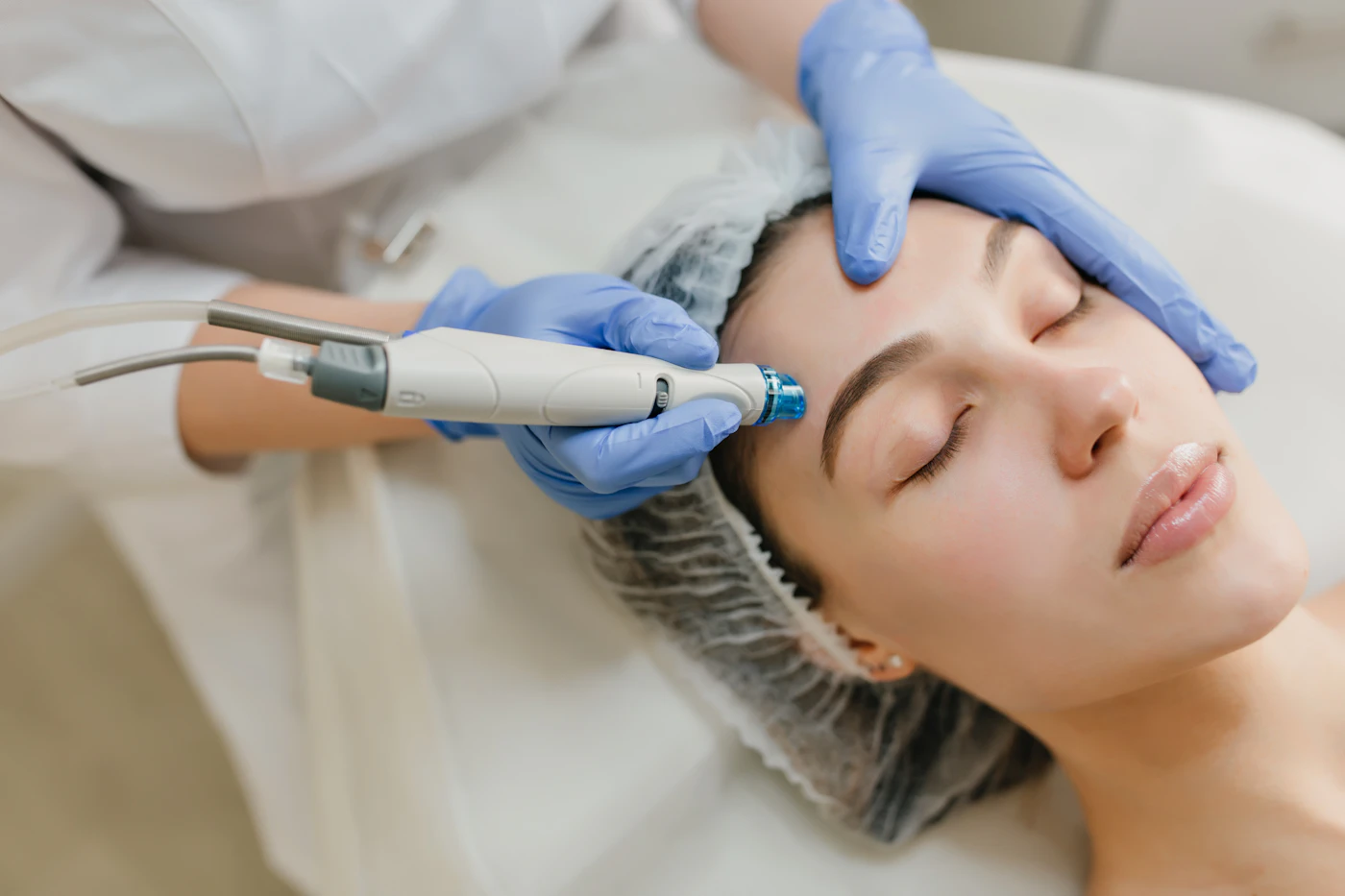
Patients comparing non-surgical options for a softening jawline or early jowl almost always run into both names. Because they are marketed for the same concern, it is easy to assume they are interchangeable. They are not. One is an energy-based collagen treatment; the other is a minimally invasive implant. Understanding the mechanism is the fastest way to know which fits a given face: and why a dermatologist sometimes recommends both.
How each one works
Ultherapy (MFU-V) delivers microfocused ultrasound to precise depths in the dermis and the superficial musculoaponeurotic system (SMAS), creating tiny thermal coagulation points. Those points trigger a wound-healing response that lays down new collagen and elastin over the following two to three months; nothing is left behind in the skin. The mechanism, depths, US FDA De Novo classification and later 510(k) clearances are covered in detail on what Ultherapy is, and MFU-V is regarded in the literature as the reference standard for focused-ultrasound skin lifting[5].
A thread lift is a different idea entirely. The clinician passes absorbable suspension sutures (commonly polydioxanone (PDO) or poly-L-lactic acid (PLLA), often barbed) under the skin and uses them to physically reposition sagging tissue. The lift is mechanical and visible immediately, and the threads also provoke some collagen formation along their path as they dissolve over months. It is a minimally invasive procedure rather than an energy treatment.
Side-by-side at a glance
| Dimension | Ultherapy (MFU-V) | Thread lift |
|---|---|---|
| Category | Energy-based (focused ultrasound) | Minimally invasive suture implant |
| What is placed in the skin | Nothing: energy only | Absorbable sutures (e.g. PDO, PLLA), often barbed |
| Immediate effect | Subtle; the change is mostly gradual | Immediate mechanical lift |
| Peak result | 8–12 weeks, as collagen and elastin remodel | Visible at once, then settles as swelling resolves |
| How long it lasts | Study follow-up often reaches 180 days; duration varies individually | Variable; review evidence shows limited durability |
| Downtime | Essentially none | Swelling and possible bruising; some social downtime |
| Most common side effects | Transient redness and swelling; rare nerve effects | Asymmetry, swelling, bruising; uncommon extrusion or infection |
| Evidence base | Multiple controlled studies; reference standard | Limited high-quality evidence for durability |
| Most suited to | Mild–moderate laxity wanting gradual, natural change | Those wanting immediate repositioning of sagging tissue |
What the evidence says about how long results last
This is where the two diverge most. For MFU-V, a retrospective evaluation at 180 days found 67% of subjects with blinded-reviewer improvement and 77.7% with physician-rated improvement after a single session, with results documented through each study's follow-up rather than a universal duration[4].
For thread lifts, the picture is more cautious. A systematic review of the thread-lift literature concluded that, over the preceding decade, little substantial high-quality evidence had been added to support durable efficacy, and that most included studies showed at best a very limited durability of the lifting effect: with the two positive studies having been sponsored by thread manufacturers[1]. That does not mean thread lifts do not work; it means the immediate lift they produce tends to be shorter-lived than marketing often implies, and that candid expectation-setting matters.
Safety profiles compared
Both are far lower-risk than surgery, but the risk types differ. For MFU-V, an open-label trial across Fitzpatrick III–VI skin reported three adverse events that all resolved by day 90 without sequelae; the main transient effects are redness, mild swelling and occasional bruising[6].
For thread lifts, an evidence-based systematic review of 59 studies covering more than 14,000 patients found the most common side effects to be facial asymmetry, swelling and bruising, with serious adverse events (such as paraesthesia or injury to vessels or glands) being rare and most complications self-resolving[2]. Because a thread is a physical implant placed along a path, its uncommon problems ( visible or palpable threads, asymmetry, extrusion) are mechanical in nature, which is a different category of issue from an energy treatment.
They are not strictly either/or
In practice the two are frequently combined rather than chosen against each other. A study of suspension threads used together with MFU-V found that thread integrity was preserved and that there was greater neocollagenesis at three months when threads were combined with MFU-V than with MFU-V alone[3]. A common sequencing is to use a thread lift for an immediate repositioning effect and MFU-V for the slower, broader collagen remodeling: though whether that is appropriate depends entirely on the individual assessment.
Which one suits you
The honest framing is that neither is universally better. MFU-V suits patients with mild-to-moderate laxity who want a gradual, natural-looking change and usually same-day return to routine despite possible short-lived redness, swelling, tenderness or altered sensation; the published consensus places it in that band[7]. A thread lift suits patients who want an immediate repositioning of specific sagging tissue and accept a more variable duration and a short recovery. The full candidacy criteria ( age, laxity grade, skin quality and contraindications) are set out on the candidates and contraindications page, and if your underlying question is really MFU-V versus generic ultrasound devices, that is covered in MFU-V vs HIFU.
Thread lifts, focused ultrasound and other non-surgical options are set side by side in an evidence review of non-surgical lifting; the recovery side of an MFU-V session is detailed on the aftercare and downtime page.
Risks and contraindications
Redness, swelling, tenderness, bruising and altered sensation can occur. Postmarketing reports also include muscle weakness, burns, nodules and fat or volume loss; their frequency is uncertain. Discuss prior fillers and implants before treatment. In a 52-patient open-label trial across Fitzpatrick III–VI skin, the three reported adverse events resolved by day 90 without sequelae[6].
The US instructions for use list open wounds or lesions, severe or cystic acne, and active or metallic implants in the treatment area as contraindications. Pregnancy, breastfeeding and anticoagulant use have not been evaluated; defer treatment during pregnancy or breastfeeding and review medications with the prescriber. Do not stop prescribed medication yourself. Avoid treating directly over an existing keloid; a history of abnormal scarring requires assessment. Korean treatment must follow the labeling for the exact device used. Thread lifting carries its own separate set of considerations, which the clinician will review if that option is on the table.
References
- Gülbitti HA, Colebunders B, Pirayesh A, Bertossi D, van der Lei B. Thread-Lift Sutures: Still in the Lift? A Systematic Review of the Literature. Plast Reconstr Surg. 2018;141(3):341e-347e.
- Pham CT, Chu S, Foulad DP, Mesinkovska NA. Safety Profile of Thread Lifts on the Face and Neck: An Evidence-Based Systematic Review. Dermatol Surg. 2021;47(11):1460-1465.
- Casabona G. Safety of Combining Facial Lifting With Suspension Threads and Microfocused Ultrasound With Visualization. J Drugs Dermatol. 2020;19(4):367-370.
- Fabi SG, Goldman MP. Retrospective evaluation of micro-focused ultrasound for lifting and tightening the face and neck. Dermatol Surg. 2014;40(5):569-75.
- Vachiramon V, Pavicic T, Casabona G, et al. Microfocused Ultrasound in Regenerative Aesthetics: A Narrative Review on Mechanisms of Action and Clinical Outcomes. J Cosmet Dermatol. 2024;24(2):e16658.
- Harris MO, Sundaram HA. Safety of Microfocused Ultrasound With Visualization in Patients With Fitzpatrick Skin Phototypes III to VI. JAMA Facial Plast Surg. 2015;17(5):355-7.
- Fabi SG. Noninvasive skin tightening: focus on new ultrasound techniques. Clin Cosmet Investig Dermatol. 2015;8:47-52.
Medically reviewed by a Korean Board-Certified Dermatologist (AAD International Fellow · ASLMS member). Last reviewed 2026-06-27. Editorially updated 2026-10-18.