What Is Ultherapy? MFU-V Technology Explained
Ultherapy® (MFU-V) delivers focused ultrasound energy at three preset depths (1.5 mm (superficial dermis), 3.0 mm (mid dermis), 4.5 mm (SMAS)) creating thermal coagulation points that trigger collagen and elastin remodeling over the following months. Real-time B-mode visualization distinguishes MFU-V from generic HIFU. US FDA pathway: De Novo classification for brow lift in 2009, then 510(k) clearances for submental and lateral neck laxity in 2012 and décolletage wrinkles in 2014. Performed only by trained clinicians; not a surgical alternative for advanced laxity.
Ultherapy® is a brand name for microfocused ultrasound with visualization, abbreviated MFU-V. The device sends acoustic energy from a handheld transducer into the skin and produces small, well-defined zones of thermal injury at controlled depths[1]. Those zones have two effects. The treated tissue contracts straight away, which gives a modest immediate tightening. Then a slower wound-healing response sets in, generating new collagen and, new elastin as observed in a miniature-swine study[2].
For patients comparing devices, the question that matters is rarely whether ultrasound is more powerful than radiofrequency or laser. It is what MFU-V actually delivers, and on which patients. Candidacy assessment, and the comparison with generic HIFU.
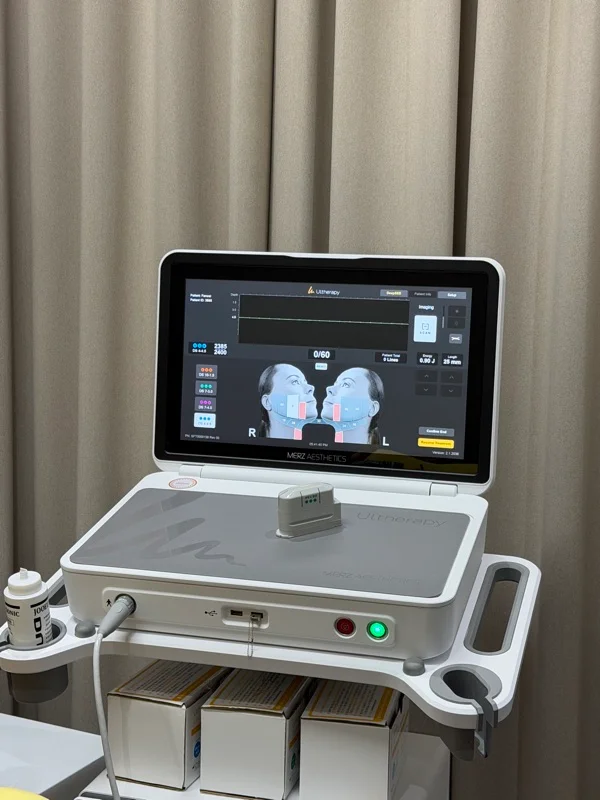
How the energy is delivered
An MFU-V handpiece carries interchangeable transducers, each tuned to a particular depth. The Ultherapy system as marketed in dermatology practices uses three standard depths (1.5 mm, 3.0 mm, and 4.5 mm) though not every patient is treated at every depth. A miniature-swine study observed thermal coagulation points and subsequent tissue remodeling[2]. The dermatologist selects depths for the individual anatomy and treatment area[3].
Each treatment line creates a sequence of thermal coagulation points at the selected depth. The visualization screen on the device shows the actual tissue along the transducer's path before the line is fired, which helps the clinician check skin contact and an appropriate treatment depth, including avoiding bone. This is the "V" in MFU-V and the single most important feature distinguishing it from generic HIFU devices that fire blind. The separate guide to what the ultrasound image shows explains the documented 0–8 mm display range, selected focal depths and the limits of what the screen can establish.
Treatment depth specifications
| Depth | Tissue layer targeted | Typical indication |
|---|---|---|
| 1.5 mm | Superficial dermis | Selected superficial tissue targets; anatomy determines use |
| 3.0 mm | Mid dermis | Dermal collagen network across the cheek; skin-texture tightening |
| 4.5 mm | SMAS (superficial musculoaponeurotic system) | Jawline and submental tissue: the layer surgeons mobilise during a facelift |
Each transducer is engineered to deliver thermal coagulation zones at one of these depths; the clinician selects depths based on the anatomy being treated[3]. The lower-face application is detailed in Ultherapy for the jawline and neck.
US FDA regulatory pathway: what it actually covers
It is common to read marketing copy that lists Ultherapy as "FDA approved" for everything from jowls to wrinkles. The accurate picture is narrower. The 2009 indication followed the De Novo pathway; the later indications followed the 510(k) pathway:
For the device-generation question, see Ultherapy PRIME vs Ultherapy.
| Year | US FDA pathway and indication |
|---|---|
| 2009 | De Novo classification: non-invasive brow lift |
| 2012 | 510(k) clearance: lax submental tissue and lateral neck skin |
| 2014 | 510(k) clearance: lines and wrinkles on the décolletage |
These are historical US regulatory milestones. Subsequent clearances include additional body indications: K260618 includes skin laxity of the abdomen, anterior and posterior arms, and knees. US clearance does not determine Korean permitted uses; ask the clinician to confirm the Korean labeling for the exact device.
What happens in the dermis after treatment
In a miniature-swine model, thermal coagulation zones showed collagen remodeling and newly synthesized elastin at day 90[2]. This is preclinical evidence of tissue response.
Patients should not expect to see the final result immediately. The day-of-treatment effect, beyond mild redness and a sense of warmth, is usually subtle. The change that matters builds quietly and is most apparent in photographs taken in consistent lighting around the twelve-week mark. The aftercare and downtime page sets out what to expect week by week.
How long the result lasts
Published studies document improvement through their defined follow-up periods, often 180 days; some small studies report selected measures to 9–12 months, but they do not establish a universal duration. Retrospective evaluation at 180 days post-treatment found that 67% of subjects showed blinded-reviewer improvement and 77.7% showed physician-rated improvement after a single MFU-V session, with no association between outcome and Fitzpatrick skin type or age[4]. Ultherapy is not a permanent treatment (no non-surgical collagen-induction modality is) and the underlying aging process continues. Maintenance timing is separate from efficacy duration and is decided after an individual reassessment. If you are weighing when in the year to book, season is not a constraint for MFU-V: the sun-exposure and timing details are in Ultherapy in summer.
No association between outcome and Fitzpatrick skin type or age[4].
What MFU-V is not for
MFU-V is a tightening and lift technology operating in the deep dermis and SMAS. It does not treat surface concerns: pigmentation, fine surface telangiectasia, acne scarring, or wrinkles that originate in muscle movement. Those concerns have better-matched tools: pigmented laser, vascular laser, fractional resurfacing, neuromodulators. A careful dermatologist combines or sequences modalities. An Ultherapy session on its own is rarely the complete answer for someone with several skin concerns.
How one clinic decides whether a session stands alone or is paired with other care is set out in Delight Dermatology's treatment process.
Pain and anesthesia
The honest answer is that MFU-V is uncomfortable, particularly at the 4.5 mm depth over bony zones (the jawline, the lower chin). Most clinics offer one or more of: oral analgesia taken before the session, topical anesthetic applied for thirty to sixty minutes, and a short course of an anxiolytic for highly sensitive patients. Local nerve blocks are also used by some clinicians. The clinical team should discuss the option mix with you at consultation; tolerance varies more than most people expect.
Risks and contraindications
Redness, swelling, tenderness, bruising and altered sensation can occur. Postmarketing reports also include muscle weakness, burns, nodules and fat or volume loss; their frequency is uncertain. Discuss prior fillers and implants before treatment. In a 52-patient open-label trial across Fitzpatrick III–VI skin, the three reported adverse events resolved by day 90 without sequelae[5].
The US instructions for use list open wounds or lesions, severe or cystic acne, and active or metallic implants in the treatment area as contraindications. Pregnancy, breastfeeding and anticoagulant use have not been evaluated; defer treatment during pregnancy or breastfeeding and review medications with the prescriber. Do not stop prescribed medication yourself. Avoid treating directly over an existing keloid; a history of abnormal scarring requires assessment. Korean treatment must follow the labeling for the exact device used.
References
- Vachiramon V, Pavicic T, Casabona G, et al. Microfocused Ultrasound in Regenerative Aesthetics: A Narrative Review on Mechanisms of Action and Clinical Outcomes. J Cosmet Dermatol. 2024;24(2):e16658.
- Marquardt K, Hartmann C, Wegener F, et al. Microfocused Ultrasound With Visualization Induces Remodeling of Collagen and Elastin Within the Skin. J Cosmet Dermatol. 2024;24(1):e16638.
- Fabi SG. Noninvasive skin tightening: focus on new ultrasound techniques. Clin Cosmet Investig Dermatol. 2015;8:47-52.
- Fabi SG, Goldman MP. Retrospective evaluation of micro-focused ultrasound for lifting and tightening the face and neck. Dermatol Surg. 2014;40(5):569-75.
- Harris MO, Sundaram HA. Safety of Microfocused Ultrasound With Visualization in Patients With Fitzpatrick Skin Phototypes III to VI. JAMA Facial Plast Surg. 2015;17(5):355-7.
Medically reviewed by a Korean Board-Certified Dermatologist (AAD International Fellow · ASLMS member). Last reviewed 2026-07-11. Editorially updated 2026-10-18.