MFU, MFU-V and HIFU: What Is Being Compared?
MFU means microfocused ultrasound; MFU-V adds visualization. HIFU means high-intensity focused ultrasound and describes a technology category, not one device. Ultherapy combines MFU with ultrasound imaging. Imaging is a feature of the named system; the term HIFU alone does not establish whether another device has it.[1]
The shared physics
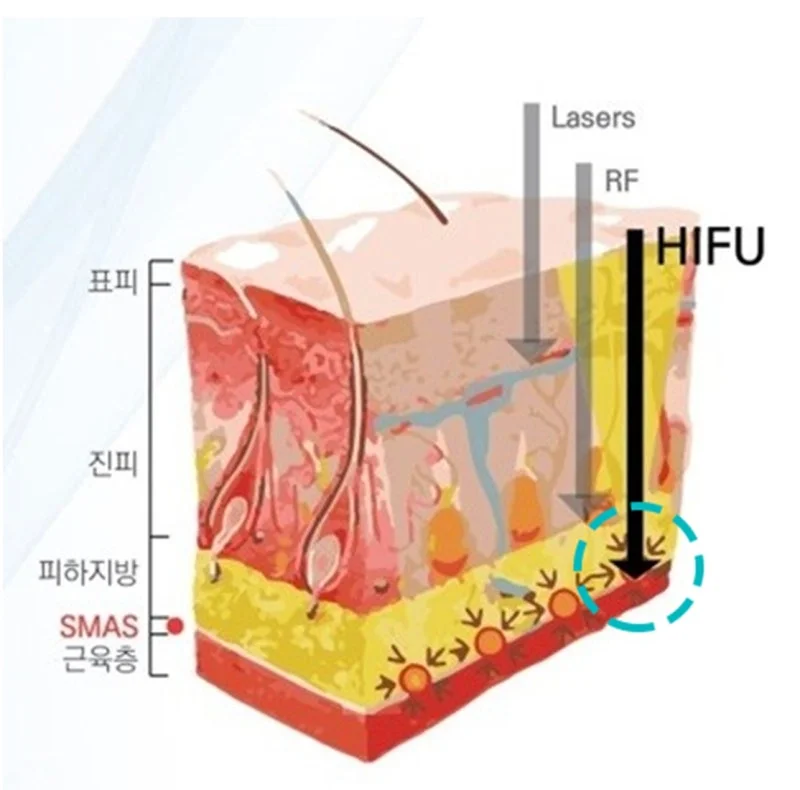
Both Ultherapy and generic HIFU devices use focused ultrasound to deposit thermal energy at a defined depth below the skin surface, producing small zones of coagulation that subsequently trigger collagen remodeling. That much is common ground. The differences begin at the transducer, the visualization layer, and the regulatory file behind the device.
The visualization layer
The Ultherapy console displays a real-time B-mode ultrasound image of the tissue under the transducer before each line is fired: visualizing tissue planes to a depth of approximately 8 mm[1]. The image helps the operator assess tissue layers, skin contact and an appropriate treatment depth.
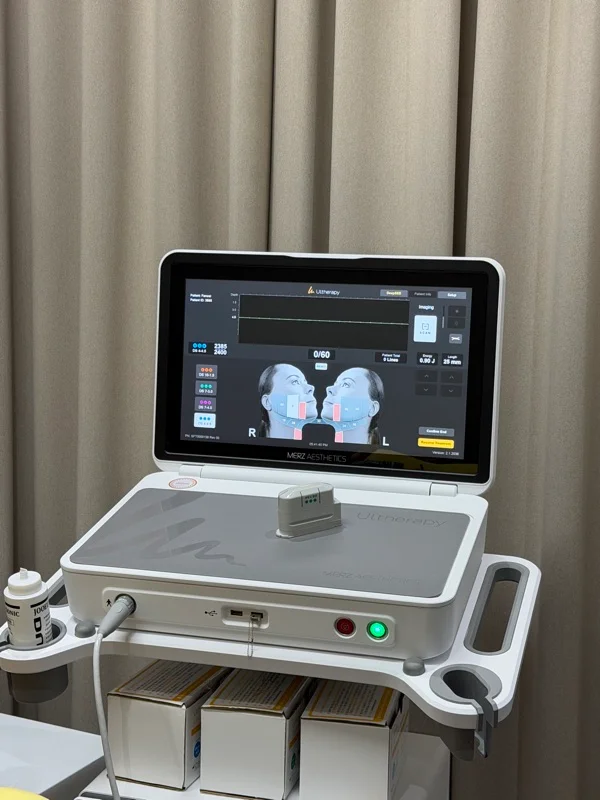
Some HIFU devices do not include real-time tissue imaging. Features vary by model; confirm the exact device and its imaging capability before treatment.
Transducer engineering
Ultherapy uses transducers with nominal focal depths of 1.5, 3.0 and 4.5 mm. Each treatment line creates a sequence of thermal coagulation points. Other HIFU systems vary in transducer design, available depths and imaging capabilities.
Regulatory pathway
Ultherapy has historical US De Novo and 510(k) decisions for specified indications. K260618 includes additional body indications. Confirm the exact device and its applicable Korean labeling with the treating clinic.
Side-by-side at a glance
The Ultherapy specifications are described in the US instructions for use. They do not supply specifications or comparative outcomes for every HIFU device. US instructions for use
| Comparison point | Ultherapy (MFU-V) | Other HIFU devices |
|---|---|---|
| Imaging | Ultrasound imaging supports tissue and contact checks | Confirm the imaging capability of the named model |
| Nominal focal depths | 1.5, 3.0 and 4.5 mm | Confirm the model and transducer specifications |
| Comparative clinical outcomes | The cited trial compares MFU-V with monopolar RF[2] | Not tested as a comparator in that RF trial |
How this plays out in Korean practice
Compare the exact device and proposed plan. Pricing depends on the areas treated and line count.
Ask who will assess and treat you, which device will be used, and how depths and lines will be planned. Korean-made HIFU devices such as Shurink, Ultraformer and Doublo, and how to confirm the exact model, are covered in a separate device guide.
How to ask about device specifics at consultation
A short list of useful questions: Which exact device is used and what is its KFDA registration number? How many transducers (1.5 / 3.0 / 4.5 mm) does the protocol include for my zone? How many lines are planned, and what is the line-count basis for the quoted price? Is there real-time visualization, and will the clinician adjust the plan based on what they see on the screen? Clinics that answer these questions plainly are easier to trust than clinics that deflect with marketing language.
What controlled trials show against other modalities
Direct head-to-head data exist. A randomized, split-face, evaluator-blind trial compared MFU-V on one side of the face against monopolar radiofrequency (MRF) on the other side in 20 subjects with mild-to-moderate laxity, followed for six months. Both modalities produced a significant improvement on the Fasil Face and Neck Laxity Grading Scale at day 30, with the gain sustained through days 90 and 180. There was no statistically significant difference between the two arms on the laxity scale or on patient satisfaction[2]. Who is a good candidate .
The comparator was radiofrequency, not another HIFU device. This trial cannot establish that MFU-V is superior to HIFU, and a nonsignificant difference does not prove equivalence.[2]
Where this leaves you
MFU-V and other lifting treatments differ in their mechanism and evidence. Compare the proposed plan, expected benefit and risks. Thread lifts use suspension sutures rather than ultrasound energy.
For radiofrequency (RF) skin tightening, see the Thermage and Ultherapy comparison.
MFU-V in practice: interval, pain, recovery
Three practical questions decide most MFU-V consultations. How often? A single session is standard; the clinician arranges result assessment before considering further treatment. Does it hurt? MFU-V delivers discrete thermal coagulation points, and pain management (topical anesthesia, pacing, depth selection) is part of the protocol: discomfort can occur during and after treatment. What recovery? Most people return to usual activity the same day; mild swelling may last 1–3 days, and visible changes develop gradually. Recovery effects and signs that should prompt a message to a treating clinic, is in the aftercare and downtime guide.
Risks and contraindications
Redness, swelling, tenderness, bruising and altered sensation can occur. Postmarketing reports also include muscle weakness, burns, nodules and fat or volume loss; their frequency is uncertain. Discuss prior fillers and implants before treatment. In a 52-patient open-label trial across Fitzpatrick III–VI skin, the three reported adverse events resolved by day 90 without sequelae[4].
The US instructions for use list open wounds or lesions, severe or cystic acne, and active or metallic implants in the treatment area as contraindications. Pregnancy, breastfeeding and anticoagulant use have not been evaluated; defer treatment during pregnancy or breastfeeding and review medications with the prescriber. Do not stop prescribed medication yourself. Avoid treating directly over an existing keloid; a history of abnormal scarring requires assessment. Korean treatment must follow the labeling for the exact device used.
References
- Fabi SG. Noninvasive skin tightening: focus on new ultrasound techniques. Clin Cosmet Investig Dermatol. 2015;8:47-52.
- Alhaddad M, Wu DC, Bolton J, et al. A Randomized, Split-Face, Evaluator-Blind Clinical Trial Comparing Monopolar Radiofrequency Versus Microfocused Ultrasound With Visualization for Lifting and Tightening of the Face and Upper Neck. Dermatol Surg. 2019;45(1):131-139.
- Vachiramon V, Pavicic T, Casabona G, et al. Microfocused Ultrasound in Regenerative Aesthetics: A Narrative Review on Mechanisms of Action and Clinical Outcomes. J Cosmet Dermatol. 2024;24(2):e16658.
- Harris MO, Sundaram HA. Safety of Microfocused Ultrasound With Visualization in Patients With Fitzpatrick Skin Phototypes III to VI. JAMA Facial Plast Surg. 2015;17(5):355-7.
Medically reviewed by a Korean Board-Certified Dermatologist (AAD International Fellow · ASLMS member). Last reviewed 2026-06-08. Editorially updated 2026-10-18.