Ultherapy Candidates and Contraindications
Ultherapy® (MFU-V) may suit mild-to-moderate facial laxity, good baseline skin quality and realistic expectations. Severe laxity may need surgical assessment. Existing keloids in the treatment area and a history of abnormal scarring require different precautions. Candidacy depends on examination, medical history and the device labeling, not age alone.
Minimal or no laxity
Skin still taut. No visible folds. Surface texture smooth.
Little laxity to treat; discuss skincare.
Mild to moderate
Fine surface lines visible. Early small folds at rest.
MFU-V may be suitable after examination.
Moderate–severe
Distinct wrinkle pattern. Moderate folds. Texture less even.
Individual assessment; consider alternatives.
Severe
Deep wrinkles and folds. Marked surface laxity and crepe-like texture.
Surgical consultation (SMAS lift) recommended.
Ultherapy works well for a defined band of patients. For others it is less suited, and sometimes outright contraindicated. The published consensus is that MFU-V is most suited for patients with mild-to- moderate skin and soft tissue laxity; patients with severe laxity and marked platysmal banding are usually better served by surgical consultation[1].
Good candidates
The clearest indication for MFU-V is mild to moderate laxity in patients who still have reasonable skin quality and bony support. Patients may have noticed:
- A softening of the jawline contour with early jowl formation, but no significant submandibular skin redundancy.
- Mild laxity of the neck (typically across the lateral neck and upper submental triangle) without prominent platysmal banding.
- Brow descent producing a tired or heavy upper-lid appearance, again in the mild to moderate range.
- Etched horizontal lines on the décolletage from sun exposure and sleeping position.
Realistic expectations are part of the candidacy assessment. A good candidate understands that MFU-V is a tightening and modest lifting treatment, that the visible change emerges over two to three months, and that published follow-up does not establish one duration for everyone. Patients expecting a surgical-grade lift from a non-surgical session are poor candidates, not because of their anatomy but because they are setting themselves up for disappointment. The aftercare and downtime page sets out that recovery timeline week by week.
Less-suited candidates
Patients with advanced laxity, significant skin redundancy, or pronounced platysmal banding are usually better served by surgical consultation. MFU-V can still offer a modest improvement in these cases, but the gap between what the patient sees in the mirror and what the patient hoped for after treatment is large. A dermatologist will sometimes recommend a combination plan: for example, MFU-V plus a thread lift, or MFU-V as a maintenance treatment after surgery: but will not suggest MFU-V alone as a substitute for a procedure the patient really needs.
Patients with very thin, atrophic, or sun-damaged skin without meaningful underlying laxity also tend not to benefit. The collagen remodeling response that drives MFU-V results depends on a healthy dermal fibroblast population. The mechanism behind it is explained in what Ultherapy is, and severely photodamaged skin may need a different first step, such as a structured topical and resurfacing protocol, before MFU-V is a useful next move.
Candidacy at a glance
| Criterion | Good fit | Less suited |
|---|---|---|
| Age range | Age considered with anatomy | Age alone does not determine eligibility |
| Skin laxity | Mild to moderate | Severe laxity or marked platysmal banding |
| Skin quality | Reasonable baseline quality with a healthy dermal fibroblast population | Very thin, atrophic, or severely photodamaged skin |
| Expectations | Tightening and modest lift; change over 2–3 months; duration reassessed individually | Expecting a surgical-grade lift from a non-surgical session |
| Prior treatments | Temporary fillers or botulinum toxin | Permanent fillers or threads in the focal path; active infection |
Realistic expectations are part of the candidacy assessment[1].
Contraindications and precautions
These are the conditions that should stop or modify a planned treatment:
| Category | Condition | Action |
|---|---|---|
| Not evaluated | Pregnancy or breastfeeding | Treatment deferred |
| Absolute | Open wounds or lesions; severe or cystic acne in the treatment area | Postponed until the area is clear |
| Precaution | Recent surgery in the treatment area | Defer until the treating clinician confirms healing |
| Absolute | Active or metallic implants in the treatment area | Do not treat the affected area under the US labeling |
| Relative | Keloid or hypertrophic scarring history | Assess scarring history; avoid treatment directly over an existing keloid |
| Relative | Active systemic autoimmune disease affecting skin | Specialist involvement before treatment |
| Not evaluated | Anticoagulant use | Case-by-case decision with the prescribing physician |
Prior fillers and threads require review of their type, location and timing. Active or metallic implants in the treatment area are contraindications under the US labeling; zone planning does not override that restriction.
Combination treatments: what the evidence supports
Many patients ask whether MFU-V can be sequenced with other dermatology treatments. Published safety data is reassuring. A retrospective review of 101 subjects who received MFU-V combined with botulinum toxin and/or temporary or semi-permanent dermal fillers within six months reported a 7% adverse event rate (bruising, swelling, paresthesia, one herpes simplex reactivation): consistent with the individual safety profiles of each treatment[2]. A separate study of suspension threads combined with MFU-V found preserved structural integrity of poly-L-lactic acid, polyethylene and polyamide threads, and greater neocollagenesis at three months when threads were combined with MFU-V compared to MFU-V alone[3]. Delight Dermatology's Ultherapy FAQ covers common questions about choosing between treatments.
7% adverse-event rate (bruising, swelling, paresthesia): consistent with the individual safety profiles of each treatment[2].
Thread integrity preserved, with greater neocollagenesis at three months than MFU-V alone[3].
What the consultation actually checks
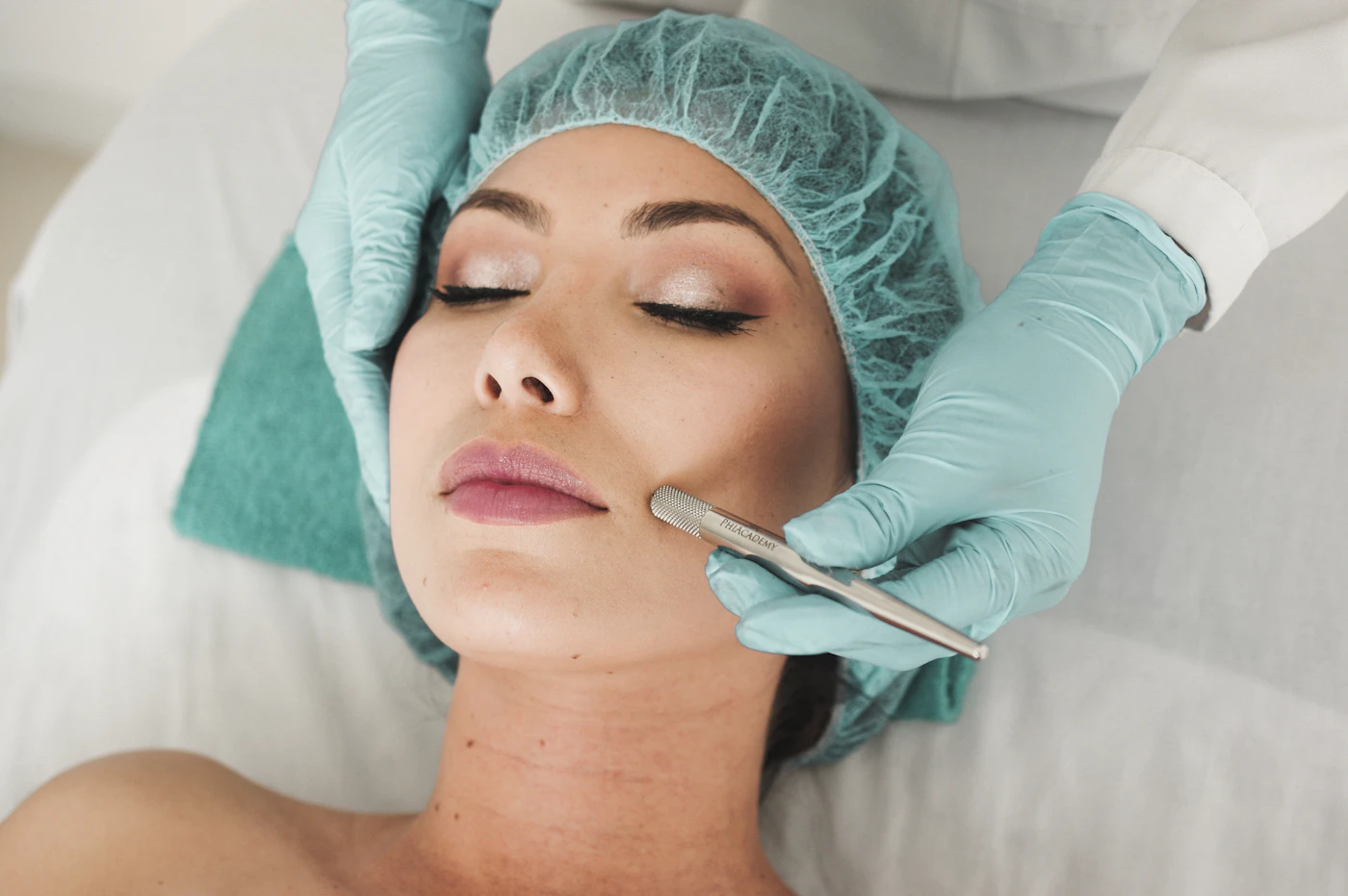
A proper consultation is not a sales conversation. The dermatologist will examine the face and neck under good light, palpate the submental and jawline tissue to assess laxity grade and skin thickness, ask about prior cosmetic treatments (including those the patient may have forgotten: threads from years ago, permanent fillers from another country), review medications, and consider the patient's photographs at rest and with animation. If a different modality is a better fit, that is what will be recommended.
Patients travelling from outside Korea may request an appointment without photographs. An optional photo and medication review can provide preliminary planning guidance, but it cannot confirm candidacy; the dermatologist makes the final decision after an in-person examination. To request a consultation you can book directly through Delight Dermatology Clinic using the main reservation page; international consultation requests go through the same channel. Common patient questions are answered in the treatment FAQ.
Risks and contraindications
Redness, swelling, tenderness, bruising and altered sensation can occur. Postmarketing reports also include muscle weakness, burns, nodules and fat or volume loss; their frequency is uncertain. Discuss prior fillers and implants before treatment. In a 52-patient open-label trial across Fitzpatrick III–VI skin, the three reported adverse events resolved by day 90 without sequelae[4].
The US instructions for use list open wounds or lesions, severe or cystic acne, and active or metallic implants in the treatment area as contraindications. Pregnancy, breastfeeding and anticoagulant use have not been evaluated; defer treatment during pregnancy or breastfeeding and review medications with the prescriber. Do not stop prescribed medication yourself. Avoid treating directly over an existing keloid; a history of abnormal scarring requires assessment. Korean treatment must follow the labeling for the exact device used.
References
- Fabi SG. Noninvasive skin tightening: focus on new ultrasound techniques. Clin Cosmet Investig Dermatol. 2015;8:47-52.
- Fabi SG, Goldman MP, Mills DC, et al. Combining Microfocused Ultrasound With Botulinum Toxin and Temporary and Semi-Permanent Dermal Fillers: Safety and Current Use. Dermatol Surg. 2016;42 Suppl 2:S168-76.
- Casabona G. Safety of Combining Facial Lifting With Suspension Threads and Microfocused Ultrasound With Visualization. J Drugs Dermatol. 2020;19(4):367-370.
- Harris MO, Sundaram HA. Safety of Microfocused Ultrasound With Visualization in Patients With Fitzpatrick Skin Phototypes III to VI. JAMA Facial Plast Surg. 2015;17(5):355-7.
Medically reviewed by a Korean Board-Certified Dermatologist (AAD International Fellow · ASLMS member). Last reviewed 2026-06-27. Editorially updated 2026-10-18.