Does Ultherapy Hurt? Pain Scores Reported in Studies
Written by Ultherapy in Seoul editorial team · PublishedThe Ulthera System instructions for use describe momentary discomfort while the energy is being delivered, and a 2025 meta-analysis that pooled 0–10 pain scores from 785 patients found a mean of 4.85, which its authors called moderate pain[1]. In a split-neck trial, scores were higher after the deeper 4.5 mm pass than after the 3.0 mm pass[2]. The pain relief most reported in these studies was numbing cream and painkiller tablets.
What the treatment feels like
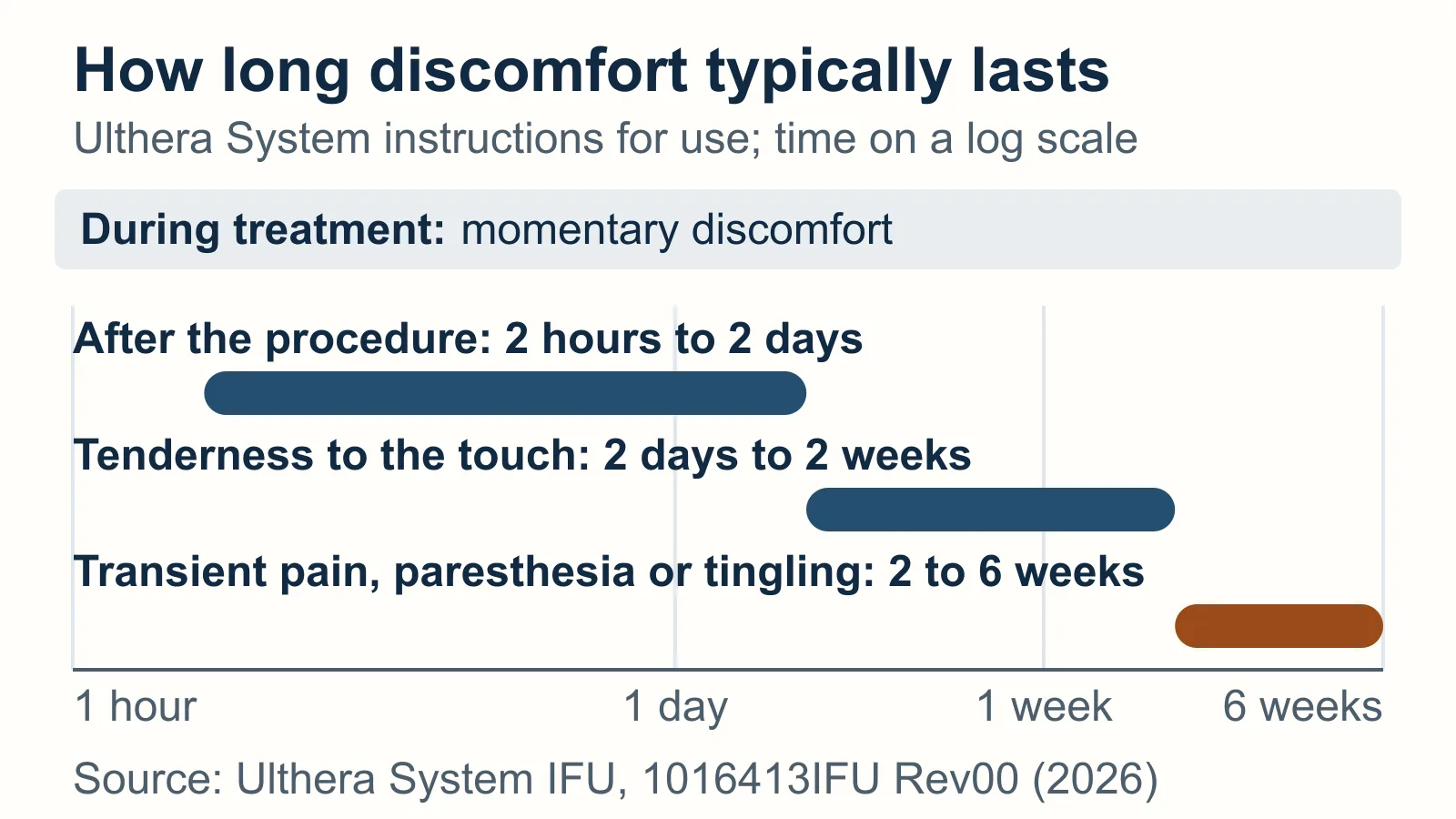
Ultherapy delivers focused ultrasound one line at a time. Each line places a row of small heated points, called thermal coagulation points, at the depth of the transducer in use; the Ulthera System instructions for use give the example of a 25 mm line at the standard 1.5 mm spacing, which holds 17 points. The same document lists pain among the effects reported in its clinical evaluation of the brow, under-chin and neck treatments: momentary discomfort while energy is being deposited, and discomfort after the procedure that "typically resolves within 2 hours and 2 days."
Tenderness to the touch can follow and typically resolves within 2 days to 2 weeks. Among nerve effects, the instructions list transient pain, paresthesia (altered sensation) or tingling, which typically resolves in 2 to 6 weeks. Recovery in general is covered under aftercare and downtime.
Pain scores reported in studies
The figures below are mean scores on 0–10 scales, where 0 is no pain.
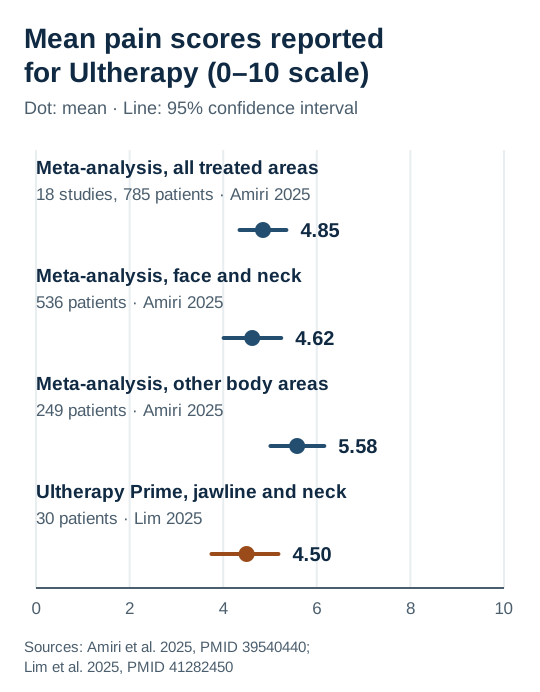
- Meta-analysis, 2025. Of 42 studies of microfocused ultrasound with visualization (MFU-V), the technology behind Ultherapy, 18 contributed to a pooled pain estimate covering 785 patients: a mean of 4.85 (95% confidence interval 4.35–5.35). Patients treated on the face and neck had a mean of 4.62 (536 patients) and those treated on other body areas 5.58 (249 patients)[1].
- Ultherapy Prime case series, 2025. Thirty patients in an Asia-Pacific case series were treated for jawline and neck laxity after numbing cream applied for at least 30 minutes, with tablets added when needed. Scored straight after treatment, pain averaged 4.50 (95% confidence interval 3.75–5.18); the median was 4.00 and individual scores ran from 1 to 10[3].
- Single-clinic questionnaire, 2025. At one clinic in Bangkok, 231 patients rated pain at a mean of 2.75 after Ultherapy Prime on a paper questionnaire completed during their visit[4].
The studies differ in the areas treated, the number of lines, the pain relief given and when pain was scored. Merz North America funded the meta-analysis, and Merz Aesthetics sponsored the program behind the Prime case series. What changed with Prime is covered in Ultherapy Prime vs Ultherapy.
Which depths and areas scored higher
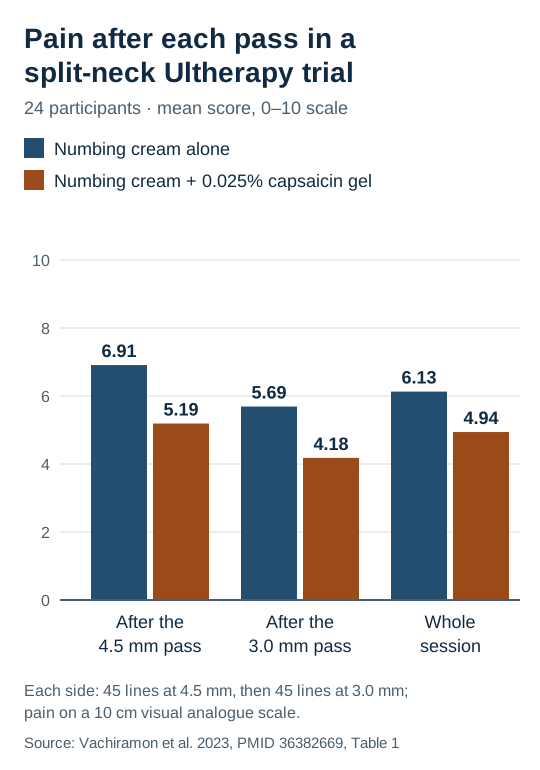
In a randomized split-neck trial, 24 participants had 45 lines with the 4.5 mm transducer and then 45 lines with the 3.0 mm transducer on each side of the neck. Each side was prepared for 30 minutes beforehand, one with a 2.5% lidocaine and 2.5% prilocaine cream alone and the other with the cream plus a capsaicin gel. On the cream-alone side, mean pain was 6.91 after the 4.5 mm pass, 5.69 after the 3.0 mm pass and 6.13 for the whole session[2].
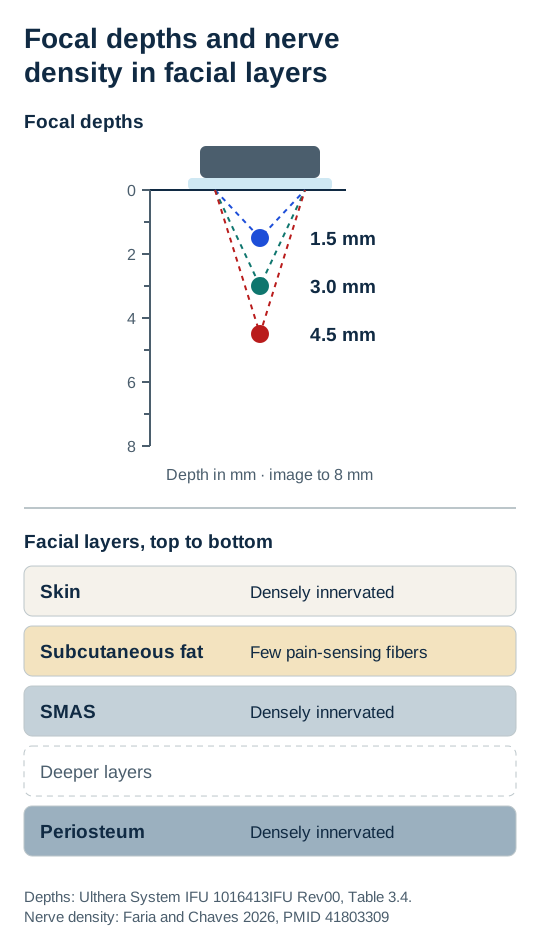
The transducers listed in the instructions for use treat at depths of 1.5, 3.0 or 4.5 mm, and the ultrasound image shows tissue to 8 mm below the skin. A 2026 narrative review of facial anatomy describes how unevenly the layers are supplied with nerves: the skin, the SMAS (superficial musculoaponeurotic system) and the periosteum covering bone are densely innervated, while subcutaneous fat contains few pain-sensing fibers[5].
Pain relief used in the studies
- Numbing cream. The Prime case series applied a topical anesthetic for at least 30 minutes[3]; the neck trial used 10 grams of lidocaine and prilocaine cream under a covering dressing for 30 minutes[2].
- Tablets. In the case series, physicians added oral painkillers when needed, at a participant's request or as their routine practice[3]. Across the meta-analysis, oral medications such as ibuprofen and paracetamol, and topical creams, were the most reported forms of pain relief[1].
- An experimental gel. In the neck trial, adding 0.025% capsaicin gel to the cream lowered mean scores to 5.19, 4.18 and 4.94. Every participant felt burning and stinging on that side, which faded within 10 minutes of removal, and redness there lasted 112.67 minutes on average against 10.38 minutes on the cream-only side[2].
Questions to ask before your session
- Which numbing cream will you use, and how long will it stay on before treatment starts?
- Will you offer painkiller tablets, and when should I take them?
- Which areas and depths are planned, and how many lines at each depth?
- Can the energy level be changed for a sensitive area, and can we pause between lines?
- Whom do I contact if numbness, tingling or soreness lasts beyond the first weeks?
For the short-lived effects one Seoul clinic lists after a session, see Delight Dermatology Clinic's answers on Ultherapy recovery. Risks beyond pain, including fat loss, are covered in Ultherapy fat loss and other reported risks.
Common questions
How painful is Ultherapy on a scale of 0 to 10?
How long does pain last after Ultherapy?
References
- Amiri M, Ajasllari G, Llane A, et al. Microfocused Ultrasound With Visualization (MFU-V) Effectiveness and Safety: A Systematic Review and Meta-Analysis. Aesthet Surg J. 2025;45(3):NP86-NP94.
- Vachiramon V, Tanratana P, Anuntrangsee T, et al. The role of topical capsaicin gel in pain management during microfocused ultrasound treatment for neck laxity. Skin Res Technol. 2023;29(1):e13240.
- Lim J, Siew TW, Xu Y. Early Experience With Ultherapy Prime in Asia Pacific: A Pilot Case Series. Plast Reconstr Surg Glob Open. 2025;13(11):e7269.
- Panithaporn D. Pain, Erythema, and Edema After Facial Lifting With Ultherapy Prime or Ultherapy Legacy-A Survey Study. J Cosmet Dermatol. 2025;24(9):e70467.
- Faria GEL, Chaves TP. Demystifying Pain During Microfocused Ultrasound: A Narrative Analysis of Facial Layer Sensitivity and Its Possible Correlation with Treatment Efficacy. Aesthetic Plast Surg. 2026;50(11):4359-4363.