Ultherapy Fat Loss and Other Reported Risks: What Records and Studies Show
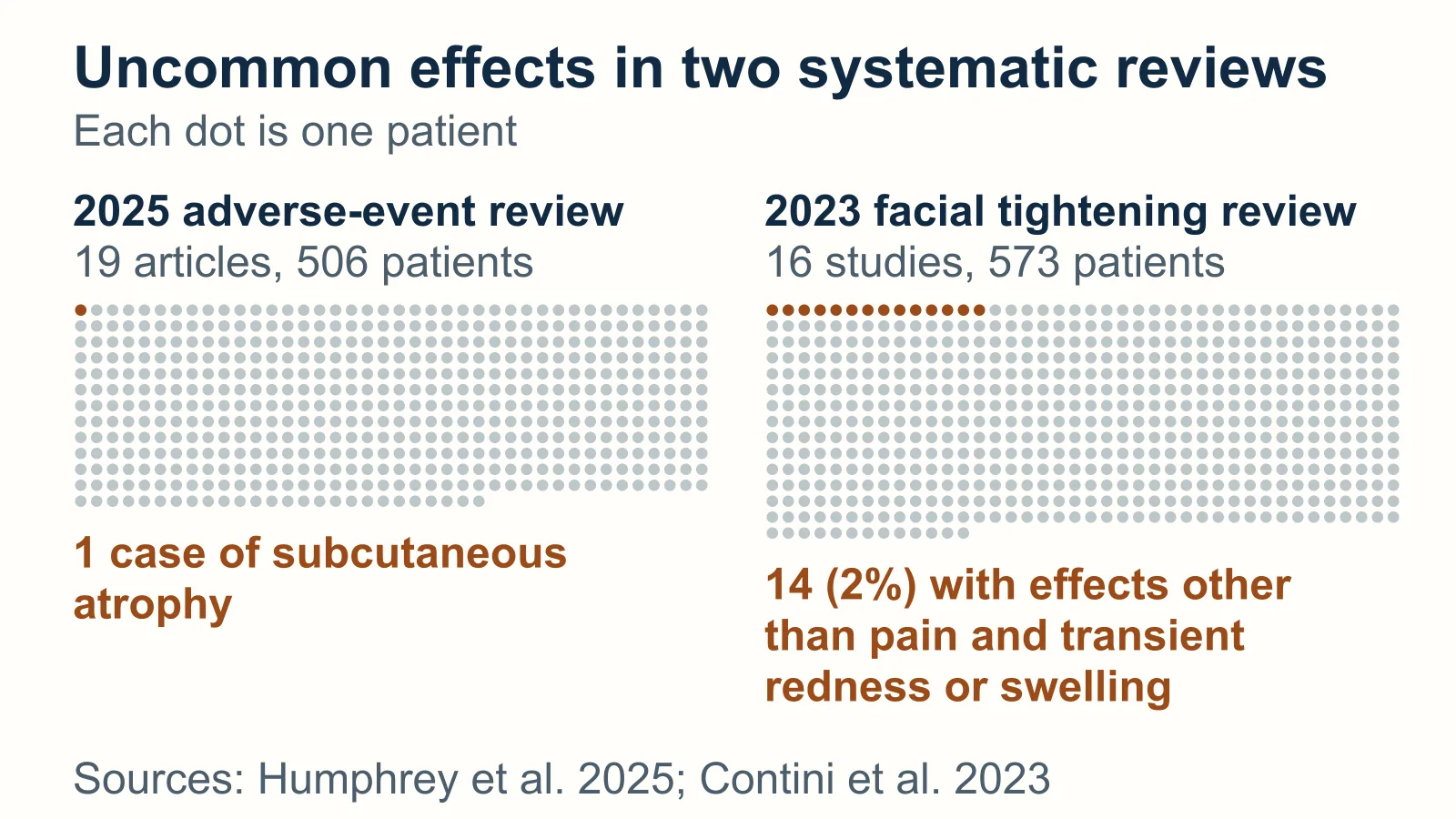
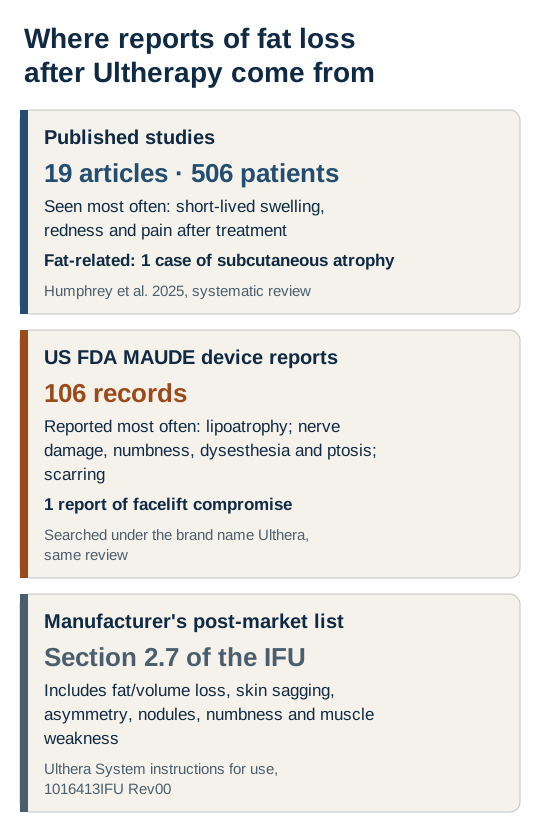
Written by Ultherapy in Seoul editorial team · PublishedFat or volume loss is on the list of adverse events that the Ulthera System instructions for use record from routine clinical use and from the literature on micro-focused ultrasound. In the published literature, a 2025 systematic review found 1 case of subcutaneous atrophy across 19 articles covering 506 patients, while lipoatrophy was among the events reported most often in 106 records from the US FDA MAUDE device-report database[1]. How much fat a face has, and the depth chosen for each area, are planning questions to raise at consultation.
What the instructions for use list
The Ulthera System instructions for use separate two kinds of evidence. Section 2.5 lists the side effects seen in the clinical evaluation of brow, under-chin and neck treatments and calls them mild and transient: redness, swelling, welting, pain, bruising and nerve effects. Burns, sometimes with scarring, are listed as possible with incorrect technique, such as a tilted transducer, incorrect line spacing or gel pockets.
Section 2.7, on post-market safety, lists events identified during routine clinical use of the system and in the wider literature on micro-focused ultrasound devices. Under skin and soft tissue it includes fat/volume loss, skin sagging or drooping, asymmetry, nodules, burns or blisters, pigmentary change and scarring. Because these events are reported voluntarily from a population of uncertain size, the document says it is not always possible to reliably estimate their frequency or establish a causal relationship to the system.
What studies and device reports show
- Systematic review of adverse events, 2025. The authors searched PubMed for MFU-V adverse events, fat loss and facelifts, and the US Food and Drug Administration's MAUDE database under the brand name Ulthera. The 19 articles covered 506 patients; transient swelling, redness and pain after the procedure were seen most often, and significant treatment-related events were limited apart from 1 case of subcutaneous atrophy. Among the 106 MAUDE records, lipoatrophy, neurologic effects and scarring were reported most frequently, and 1 record described facelift compromise. The authors describe the facelift reports as anecdotal and largely unverified[1].
- Systematic review of facial tightening, 2023. Of 16 studies of a single microfocused ultrasound treatment, 11 used the Ulthera system. Effects other than pain and transient redness or swelling were noted in 14 of 573 treated patients (2%): bruising, transient dysesthesia, a wheal, skin burns, white linear striae of the neck and dermal white papules[2].
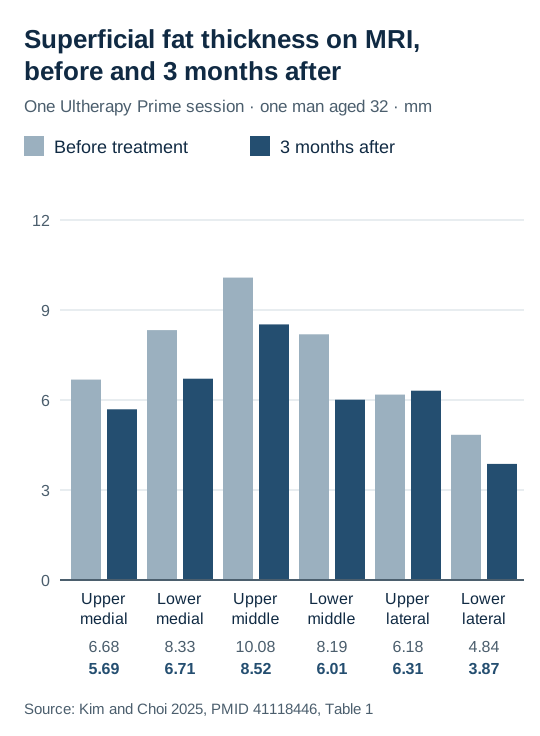
A 2025 letter to the editor by Kim and Choi measured one case with MRI. A 32-year-old man had one Ultherapy Prime session to the midface, 240 shots at 0.9 J at 4.5 mm and 380 shots at 0.35 J at 3.0 mm, while his body mass index moved from 23.0 to 23.3. Three months later, most treated areas showed thinner superficial fat, and the SMAS was about 0.1 mm thicker. The authors could not tell whether the thinner fat reflected tightening of the retinacula cutis, the fibrous strands that run through the fat, or fat breakdown. They recommend real-time ultrasound guidance to avoid placing too many heated points in that layer, especially in patients predisposed to lipoatrophy[3].
Facial fat, body weight and treatment planning
Studies of microfocused ultrasound often excluded people with excess subcutaneous fat or a body mass index above 30, and two studies linked a lower body mass index with better outcomes, one reporting higher patient-rated improvement at 25 or below[2]. The instructions for use discuss thin fat in their section on the arms and knees: patients with a low body mass index may have below-normal fat relative to skin, which may increase the risk of injury to nerves and vessels of the arm, and significant weight loss may leave a thin fat layer and stretched anatomy.
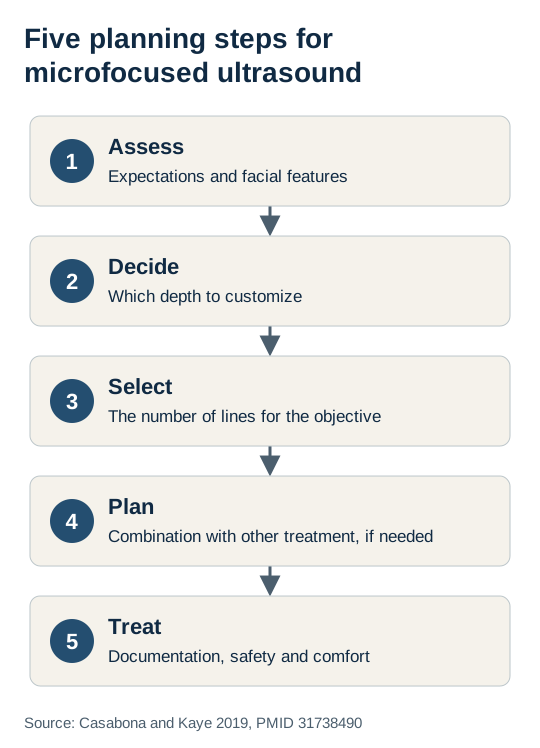
A 2019 review proposed five planning steps for microfocused ultrasound: assess, decide which depth, select the number of lines, plan any combination and treat. Its authors name visualization with ultrasound and real-time evaluation of structural changes, such as bone or fat loss, as the two most important tools for precision and efficacy[4]. The instructions for use describe the imaging as a way to see the dermal and subdermal layers, check that the transducer is coupled to the skin and confirm an appropriate treatment depth, such as one that avoids bone.
Nerve effects, burns and technique
From the clinical evaluation, the instructions for use list transient local muscle weakness and numbness that may follow inflammation of a motor or sensory nerve, typically resolving in 2 to 6 weeks. Their post-market list of neurological events includes numbness, paresthesia, palsy or paresis, speech difficulty, headache or migraine and vision changes, and notes that nerve effects lasting for months have been described.
Several warnings in the instructions concern technique: too much or too little gel obstructs skin contact, improper coupling of the transducer could cause adverse events, and delivering lines without adequate spacing could overheat tissue. Pain during and after a session is covered in does Ultherapy hurt, and conditions that rule treatment out in candidates and contraindications.
Questions to ask at the consultation
- Will you look at my fat layer on the ultrasound image before choosing depths, and where is it thin?
- Which depths and how many lines will you use in each area, and why?
- Are there areas you would treat less or leave out because the fat there is thin?
- Will the depths, line counts and energy levels be written in my record?
- Whom do I contact if I notice a dent, numbness or weakness afterwards?
Delight Dermatology Clinic's description of depth planning with imaging shows how one Seoul clinic presents this step.
Common questions
Can Ultherapy cause fat loss?
Can Ultherapy cause nerve damage?
What did the MRI case show about fat after Ultherapy?
References
- Humphrey VS, Rambhia PH, Gmyrek R, Chapas A. Microfocused Ultrasound With Visualization: A Systematic Review of Adverse Events and Risk of Subsequent Facelift Compromise. Dermatol Surg. 2025;51(4):424-429.
- Contini M, Hollander MHJ, Vissink A, Schepers RH, Jansma J, Schortinghuis J. A Systematic Review of the Efficacy of Microfocused Ultrasound for Facial Skin Tightening. Int J Environ Res Public Health. 2023;20(2):1522.
- Kim JH, Choi WS. MRI-Based Assessment of Microfocused Ultrasound-Induced Midface Lifting. J Cosmet Dermatol. 2025;24(10):e70477.
- Casabona G, Kaye K. Facial Skin Tightening With Microfocused Ultrasound and Dermal Fillers: Considerations for Patient Selection and Outcomes. J Drugs Dermatol. 2019;18(11):1075-1082.